
It seems like everyone is talking about mental health. This is most obvious in the media, but increasingly people are having conversations about mental health in day to day life. Despite this, we often find ourselves stuck when it comes to helping others and ourselves, and helping is more than just talking and listening. How can we best help with the skills and knowledge that we have, and how might we develop our helping capacity? There is a range of ways to help when it comes to supporting someone, including yourself, through the struggles and challenges of life. Here are eight helping roles to consider for yourself and others.
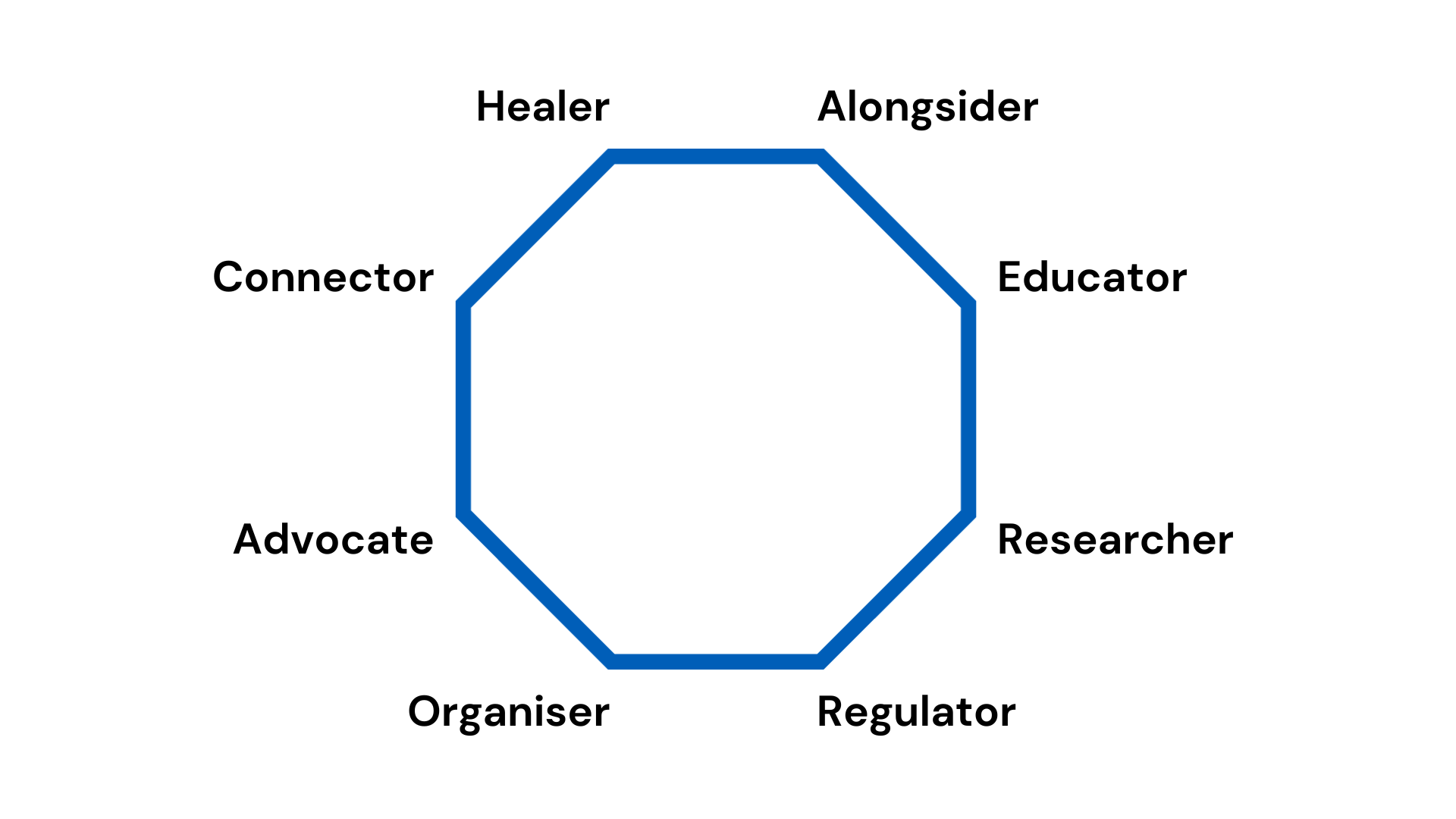
The Healer
The Healer is probably the role that first comes to mind for many when it comes to helping in the context of mental health. Healers include therapists (e.g., counsellors, psychotherapists, psychologists, psychiatrists, general practitioner doctors), clergy, and traditional healers, who are trained to work in a healing capacity, typically for more troubling or problematic issues, where others are ill-equipped to help in a restorative capacity. Contact tends to be occasional and planned, and help is usually interactive and provided directly, in person or virtually. Healers may work within a scientist-practitioner framework or evidence-based approach. Those in a professional, regulated role must work in accordance with be an ethical code of conduct, and within a contract that must be respected mutually. This role tends to offer the highest degree of confidentiality. There can, however, be a steep power gradient between the Healer and the person being helped, and this may have unintended (or even intended) consequences. Healers can also occupy spaces that have traditionally been the realm of other roles (a documented example is grief counsellors supplanting Alongsiders and Connectors in helping people with normal grief). Professional healers also often charge a fee, but this is not always the case. Healers who work in an evidence-informed way are typically connected to Researchers.
The Alongsider
The Alongsider is the most common helping role. Alongsiders include friends, neighbours, colleagues, support group members, and others with whom we have a relationship, such as a friendship or affinity, and who support us in non-directive way, usually without any formal training, contract, or explicit agreement. Help may involve listening, providing advice, gentle challenge, and providing practical support. Accordingly, Alongsiders typically offer proactive, day-to-day support as well as reactive support. Alongsiders are usually non-professional, but professionals may also adopt an Alongsider role. For instance, this may be the preferred mode of helping of non-directive therapists, coaches and mentors. This may also be the mode of help actually wanted by clients, even if this is not the default mode of the helper. The everyday Alongsider is one of the most important helping roles, and yet one of the most overlooked. Non-professional Alongsiders usually care in a genuine way that is not commodified, commercialised, contracted, or curricularised. On the other hand, the non-professional nature of help provided by Alongsiders can mean that advice and other help is inappropriate or misdirected, and breaches of trust cannot be referred to a professional regulator. Alongsiders may be connected to Connectors, who have an important role to play in connecting people.
The Educator
The Educator helps people to learn about mental wellbeing and its influences, and how to help maintain or improve their own or others’ mental wellbeing. This can be a role of teachers, therapists, and doctors, or family members, friends, and social network users. Professional Educators may work in any sector, such as education, healthcare, commercial organisations, or community settings, in a direct educational role, or in almost any setting in an indirect helping role (e.g., writing, podcasts, videos). Educators can provide information about mental wellbeing and associated influences (biological, psychological, social, job, environmental and other factors), as well as personal, interpersonal and organisational interventions. Educators are typically connected to Researchers, via the use of research findings and recommendations.
The Researcher
Researchers gather information about mental health and associated preventative and restorative interventions, conduct and publish studies to collect data about mental health, develop new interventions, and evaluate the effectiveness of interventions. Most of us act in this role to try to gather information about mental health. But professional Researchers tend to be highly trained specialists, typically to PhD or MD level. They may work in universities, agencies, health facilities, or government agencies, and may conduct studies with a sample of people with mental health issues for the purpose of research. Some of these people may be helped directly via interventions under evaluation, so the Researcher and Healer roles overlap. Others may be helped indirectly through access to evidence-based interventions. Researchers typically employ scientific thinking and methods, and research ethics are fundamental to the conduct of studies. Researchers are critical for the evidence base on mental wellbeing, especially in an age of heavily marketed interventions, including medications, talking therapies, supplements, practices, and devices, which vary in effectiveness. Researchers are typically connected with Educators, and often have dual roles. Other roles use the products of Researchers, such as Regulators and Healers.
The Regulator
Regulators include people that have a regulatory role on factors that influence mental wellbeing, including jobs, environments (e.g., workplaces, educational establishments, accommodation, healthcare facilities), and direct interventions that are designed or claimed to improve wellbeing (e.g., medications, talking therapies, supplements, devices and practices). Some Regulators work in a professional and official regulatory capacity, including state regulators and professional organisations with regulatory and oversight roles, for instance responsible for ensuring that mental health care is safe and effective, and that employers make adequate provisions to protect wellbeing. These Regulators set standards, oversee compliance, and investigate complaints. Others in a regulatory role include those with responsibilities for wellbeing in a work, educational, domestic, or other context, such as managers, HR specialists, teachers and parents. Because of their power in decision making, regulators can have a strong and systemic influence on wellbeing (for better or worse), though this is often overlooked. Regulators are typically most connected to Organisers, Healers, Educators, and Researchers, whose work is affected by the decisions of Regulators
The Organiser
Organisers include people in a variety of roles who direct, arrange and facilitate activities, jobs, staffing, resources, and environments in a range of settings (e.g., workplaces, educational establishments, accommodation, healthcare facilities, homes). Organisers have powerful physical and psychosocial influences on wellbeing that are often not well understood or even acknowledged. Many jobs have an organising role, including supervisors and managers, health and social care workers, community organisers and specialists in functions such as human resources, health and safety, staff planning, and policy writing. Even roles such as architecture, facility design and equipment commissioning have a passive but powerful organising role. Outside of organisations, the most numerous Organisers are parents and carers. Organisers may have direct contact with those whose wellbeing is affected, or have no direct contact but make decisions that affect the work and lives of others (e.g., via decisions about rostering, staff planning, task allocation). The extent to which Organisers are aware of, educated about, or care about these impacts varies significantly. Organisers are typically most connected to Regulators.
The Advocate
Advocates work formally and informally to speak for, support, or represent people when it comes to mental health and wellbeing, and raise awareness of aspects of mental wellbeing. They may advocate for the rights of people with mental health needs, including accessible healthcare and non-discrimination. Advocates may be individuals (e.g., family members), groups (e.g., campaign groups, community groups) or organisations (e.g., charities), and work in a variety of settings, including healthcare, education,, communities, and government. Advocates play an important role in helping to raise awareness, reduce stigma, get justice, and generally ensure that people have a voice in decisions that affect their lives. Advocates very often include those who experience problems of mental wellbeing, who advocate for themselves and others. However, when inadequately connected to the people being advocated for, Advocates can do harm. Advocates may be connected to any other role in seeking to influence in different ways, especially those with more power (such as Regulators and Organisers).
The Connector
Connectors connect people to other people and resources. Connectors can be found local communities, and work in a variety of settings. According to McKnight and Block in their book Abundant Community, these connectors, typically: are well connected themselves; see the ‘half-full’ in everyone; create trusting relationships; believe in their community; and, get joy from connecting, convening and inviting people to come together. Connectors understand others’ gifts, skills, passions, even those at the edges of the communities. They have an outlook based on opportunities, but do not connect out of self interest, and they are not ‘influencers’ or ‘networkers’. Connectors don’t necessarily see themselves as such, and don’t see connecting as a role; it’s a way of being. Connectors are connected to and may connect people to any of the other roles, such as Healer, Alongsider, or Advocate.
Helping, Seeking and Accepting Help, and Helping Yourself
Each of these helping roles is part of a tapestry of mental health support, and they are often interconnected. What I have found useful in reflecting on help, both for myself and others, is to ask questions about the why, what, where, how, when and who concerning offering, seeking, and accepting help, and helping myself; we act in each of these roles for others and for ourselves. Each role has benefits and risks, but reflecting on the roles can help to ensure that help really does help.
Resources
There are many books on helping others (and of course many more on self help). Most books on helping are for professionals and specialists, but some are suitable for a wide range of people. These are just some that I like.
- The Skilled Helper, by Gerard Egan
- On Becoming a Person, by Carl Rogers
- First Steps in Counselling, by Pete Sanders
- Trauma Stewardship: An Everyday Guide to Caring for Self While Caring for Others, by Laura van Dernoot Lipsky
- Abundant Community, by John McKnight and Peter Block
- Community: The Structure of Belonging, by Peter Block
- The Connected Community: Discovering the Health, Wealth, and Power of Neighbourhoods, by Cormac Russell and John McKnight
- Rekindling Democracy: A Professional’s Guide to Working in Citizen Space, by Cormac Russell
- Mental Health and Wellbeing in the Workplace: A Practical Guide for Employers and Employees, by Gill Hasson and Donna Butler
- Courage to Change: One Day at a Time in Al-Anon (Part I and II), Al-Anon Family Groups
- HindSight 30 – Wellbeing, by EUROCONTROL

 Humanistic Systems
Great article Steven.
Like the helping octagon and your description of each type. Very informative and easy to understand because of the examples you provided for clarity. Appreciate the work you put into this.
LikeLiked by 1 person