
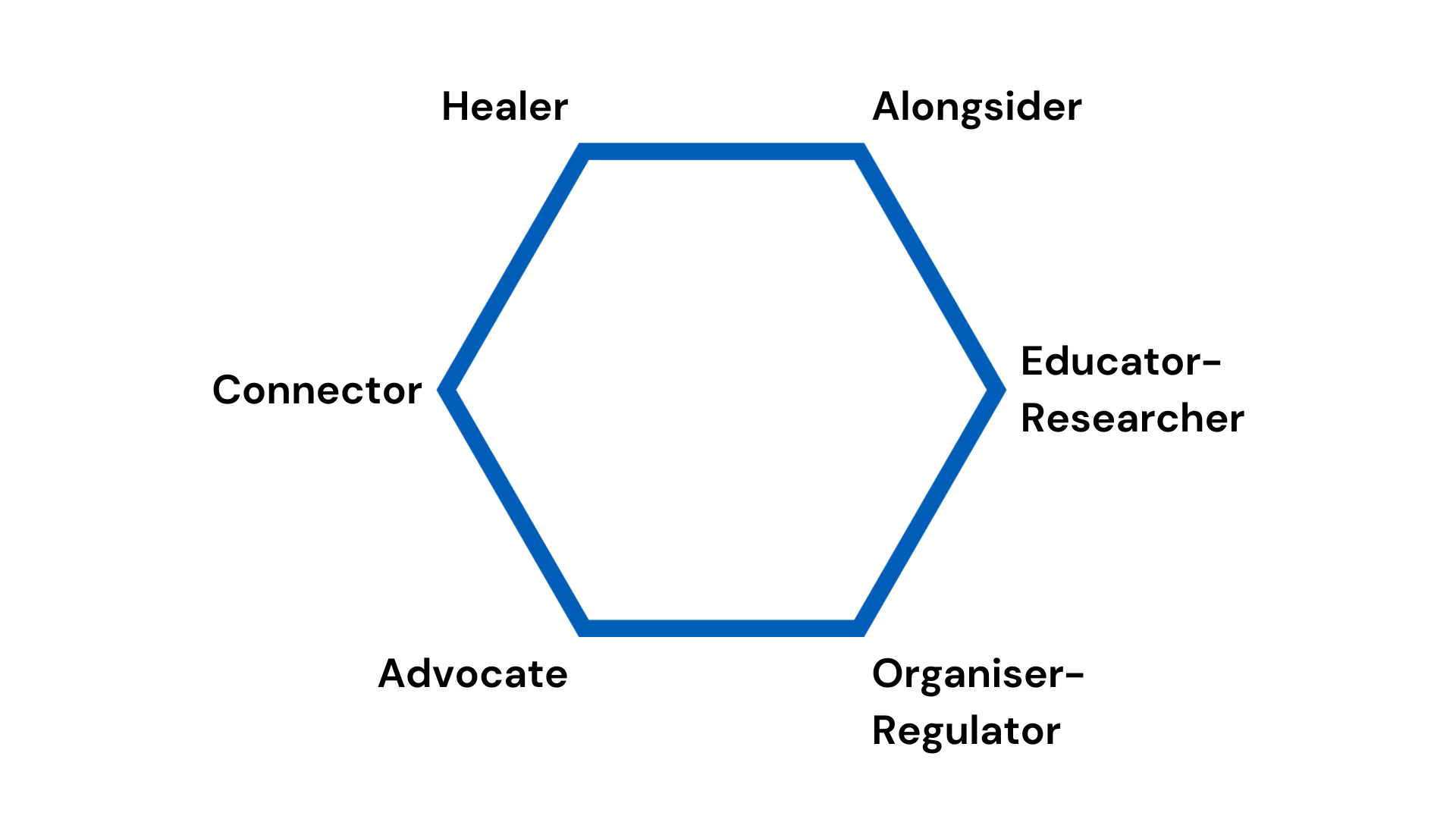
In my previous post on the Helping Octagon, I outlined eight roles relevant to helping people through the struggles and challenges of life. The roles are all important, but we tend to associate some roles with mental health and wellbeing directly, and other roles only indirectly or not at all. We also generally think of other people – and a range of people – as occupying these roles. These people are often difficult to access directly. What we may not always appreciate is that each of us often occupies each of these roles for ourselves (as well as for people we love and for whom we care). In doing so, change is done by us and with us. The Helping Hexagon is an adaptation of the Helping Octagon, with four of the roles combined into two. One way to use the Helping Hexagon is to ask ourselves questions of ourselves for each role. This post presents some possibly useful questions from my own experience, from which you can generate your own questions.
The Healer
The Healer role helps to lessen suffering and improve wellbeing via a commitment to healing activities.
- How might I engage in self-therapy? What resources are available (e.g. workbooks, videos, journaling, online self-help cognitive-behavior therapy)?
- How might I engage in activities that bring me joy, relaxation, and meaning?
- What forms of healthy physical exercise am I drawn to and am likely to be motivated to engage in?
- How might I spend more time in nature?
- Which relationships do I find supportive, restorative, and uplifting, and how can I better connect with these people?
- What role might meditation, mindfulness, and journaling play in my mental wellbeing?
- How can I connect with others to help support them in their healing?
- What professional healing support might be helpful to me?
The Alongsider
The Alongsider role typically involves proactive, day-to-day support as well as reactive support. We might be able to act as our own Alongsider in a variety of ways.
- How might I talk to myself in a way that a good and valued friend would talk to me?
- How might I be a good Alongsider for my future self? What can I do now that will take me toward the future life that I might want?
- How might I connect with my community, and become a more active member of my local community?
- What ‘part’ of myself do I recognise as being a good Alongsider? How can I make this part (and its voice) more salient, and pay more attention to it?
- How can I keep my values in mind in day-to-day life?
- How can I be a good Alongsider to others?
- Who are the good listeners and trusted advisors in my life? Who do I find good company?
The Educator-Researcher
The Educator-Researcher role helps us to facilitate our own learning about mental wellbeing and its influences, and how to help maintain or improve our own mental wellbeing via personal, interpersonal and organisational interventions.
- From what sources might I seek valid and trustworthy information about mental health?
- How can I invest time to educate myself on mental health and wellbeing?
- How might I best record the insights that I am gaining?
- How can I focus and avoid overwhelm?
- When might I need to educate others and how might I do this to best effect?
- How might I connect to other Educators?
The Organiser-Regulator
When applied to the self, we might adopt the Organiser-Regulator role to influence, facilitate, set standards on, monitor factors that influence our mental wellbeing, including activities, jobs, environments, relationships, and interventions to improve wellbeing.
- What matters to me and how might I clarify this for myself?
- How can I record aspects of my mental health and well-being?
- What activities help me to regulate my emotions?
- How might I limit activities and commitments that are undermining my mental health?
- How can I ensure that I prioritise my mental health in light of other competing values and demands?
- What might I start, stop and continue doing for my own mental health? Where should I start?
- What boundaries do I need to set for my own mental health (e.g., people, places, activities, things)?
- Who can help me in my self-organisating and self-regulatory roles?
The Advocate
The self-Advocate role involves speaking for or representing yourself when it comes to mental health and wellbeing, and raising awareness of aspects of mental wellbeing.
- How might I need to advocate for myself, including my capabilities and needs, in different contexts and systems (e.g., healthcare, employment, citizenship)?
- Who can help me to advocate for myself, and who can advocate for me when needed?
- When might be appropriate for me to advocate for others in a similar position to me, and how might I do this in a way that facilitates my growth, while also protecting myself?
- How can I advocate for myself to myself, ensuring that I attend to my own needs?
The Connector
In a Connector role, we can connect ourselves and others to other people, resources and organisations, associations and institutions in the interests of our own and others’ mental health and wellbeing.
- How can I connect myself to other people in particular roles?
- Who are the Connectors that I could connect with?
Connecting and Strengthening the Roles
As with the Helping Octagon, there are relationships between these roles even as we fulfil them for ourselves. For instance, in the Educator-Researcher role we find activities, people and environments that help us in the Healer role, and are more informed in order to advocate for ourselves in the Advocate role. The Advocate role can strengthen the regulatory aspects of the Organiser-Regulator role. You may find that you pay more attention to some roles than others, or are stronger in some than others. This itself is something worth paying attention to in our efforts to attend to our own mental health needs.

 Humanistic Systems