
This is the third of seven realities in this series on living with chronic conditions and dynamic disability, explored through language, concepts and images from Celtic folklore.
The invisible burden of chronic conditions involves constant unseen work to manage symptoms, needs, duties and relationships, and, through it all, to try to function. Life can become constrained by, and even structured around, the condition and disability: medicines, calculations, routines, rest, and appointments. Few have visibility or insight into this, as most visible signs are in private spaces, behind closed doors. The mental, emotional, physical, social, and financial tolls are even less visible, and generally not acknowledged outside of patient communities, families, and specialist research literature1.
For many conditions, such as ME/CFS, long Covid, Lyme disease, and multiple sclerosis, part of the invisible burden concerns energy and fatigue. Available energy can be severely limited, and profound fatigue can constrain even the most basic activities2-5. This makes it necessary to calculate, budget and ration energy. “If I walk there, will I be able to walk back?” “How much energy will this social event require?” “How long will I need to rest in order to recover?” The burden arises both from the energy-limiting condition itself, and from the management strategies that are necessary to live with it.
Other symptoms present different or additional burdens. These include pain, cognitive dysfunction (brain fog), unrefreshing sleep, gut problems, orthostatic intolerance, dizziness, gait instability, sensory overload and, in the case of ME/CFS, post-exertional malaise (PEM)2. To some degree, people with chronic conditions may ‘push through’ and conceal, mask or camouflage these symptoms6,7. There are several reasons for this. One is that it may simply be necessary to get through the day, whether that is to wash oneself, go to work, take children to school, prepare food to eat, or simply to get home from wherever you are. Financial survival may depend on pushing through if there is no other means of support. Another reason is more social: avoiding social isolation, sparing loved ones from seeing suffering, or pressure to be productive or ‘positive’. Finally, there is the internalised ableism and grief that many people with chronic conditions experience. The grief of losing one’s old life and self can be compounded by confusion, guilt, and shame8. Pushing through and masking may help someone meet an immediate demand, but can come with significant consequences for symptoms and capacity, depending on the condition, especially when repeated over time2.
This burden is not always recognised or discussed by medical professionals. In fact, the journey through healthcare systems can paradoxically add to it1. This includes the pursuit of diagnosis and treatment, repeated appointments and explanations, and the medical gaslighting that can be encountered9,10. This can create an additional pressure to appear calm, rational, and cooperative in order to be taken seriously, and to avoid dismissal or misdiagnosis.
From folklore, the Cailleach and Brân the Blessed give us complementary ways to understand this invisible burden.
The Cailleach (literally old woman, hag) appears in Irish, Scottish and Manx lore in many forms11,12. In Scottish tradition, she is strongly associated with winter, storms, cold, wilderness, mountains, and with the shaping of the landscape. Stories attribute mountains, hills, islands and lochs to her actions. She is sometimes described as bringing winter and resisting the arrival of spring, although the traditions surrounding her are diverse and extend beyond this seasonal role.
The Cailleach need not be seen as simply destructive, however. Winter brings contraction, dormancy and reduced activity, but is also part of an ancient cycle of survival and renewal. In some traditions she is associated with deer and other wild animals, and with the management or protection of the landscape through the winter months12,13. She is therefore a figure not only of harshness, but of conservation, endurance, seasonal change and eventual renewal.
One Scottish tradition associated with Ben Cruachan concerns the Cailleach guarding a well. She was required to cover it each night and uncover it each morning, but one night she overslept and the water escaped, flooding the valley and creating the River and Loch Awe13. Even this immensely powerful supernatural figure, associated with winter, mountains and the shaping of the land, is not endlessly vigilant or without limits.

Image: “Beira, Queen of Winter”, John Duncan, from Wonder Tales from Scottish Myth and Legend, Donald Alexander Mackenzie, 1917.
Brân the Blessed (Bendigeidfran) was the gigantic king of Britain in the Second Branch of the Mabinogi14,15. His story concerns his sister Branwen’s marriage to the Irish king Matholwch, the breakdown of relations between Britain and Ireland, and an eventual catastrophic war. Brân was so enormous that no ordinary house could contain him. He waded across the Irish Sea while his companions travelled by ship14,15. His story portrays his physical strength, but also responsibility, family, protection, sacrifice and loss.
One episode provides a literal image of burden. When the Irish destroy a bridge across a river to prevent Brân and his army from crossing, he lies across the river himself so that his followers can cross over his body. This is associated with the Welsh proverb A fo ben, bid bont: roughly, “he who would be a leader, let him be a bridge”.
Despite his strength, Brân remains vulnerable. During the war in Ireland he was mortally wounded by a poisoned spear. Almost everyone involved in the conflict died, and Brân instructed the few surviving companions to cut off his head and return it to Britain. His head continued to accompany and speak with them for many years before eventually being buried in London, where it took on a continuing protective role14,15. Brân’s form and capacities were radically altered, but his significance and contribution continued.
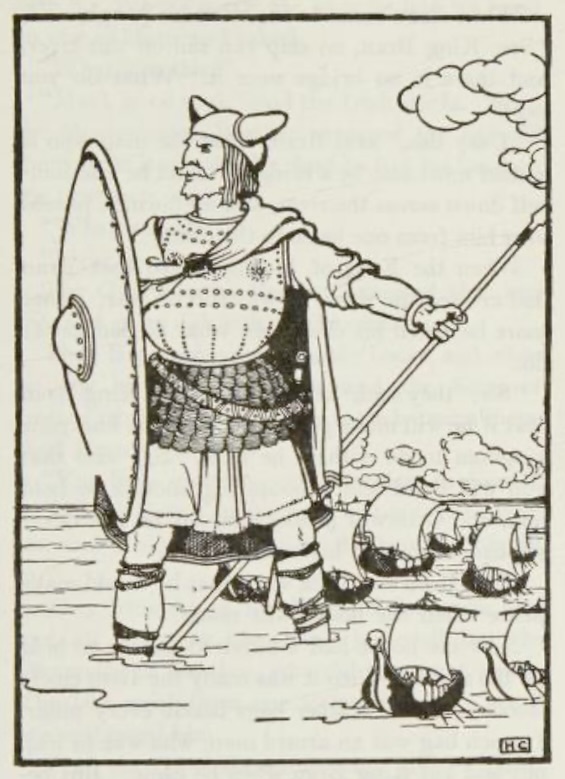
Image: “Brân the Blessed”, Hugh Chesterman, from Mighty Men, Eleanor Farjeon, 1925. The book was illustrated by Chesterman.
The Cailleach and Brân offer different but complementary ways of thinking about invisible burden. The Cailleach brings to mind the necessity of contraction, conservation and living according to changing conditions. Brân brings to mind the burden of carrying responsibilities and relationships, even when one’s own capacity is limited. This is all relevant to living with chronic conditions.
The Cailleach‘s association with winter is especially relevant. Winter involves contraction, withdrawal, reduced activity and conservation, but life has not disappeared; dormancy is part of an ancient, adaptive cycle of survival and renewal. Modern life, however, is organised much less around such cycles. Certain responsibilities generally continue regardless of health or available capacity. There is an expectation of fairly consistent functioning, and reduced activity can be misinterpreted.
For many people with chronic conditions, the body or mind violates this expectation. There may be periods of greater capacity and functioning, and others in which activity, stimulation and social engagement have to be reduced substantially. In this sense, the Cailleach may help to characterise the necessity and burden of withdrawal and conservation. Rest should not be seen as an absence of activity. It may be an active process of managing symptoms, preventing deterioration, recovering from exertion, or preserving enough capacity for essential activities1,2. Much of this is invisible because it takes place at home, often lying down, and may look from outside like doing nothing6,7.
The Cailleach‘s close relationship with weather, landscape and season also brings to mind the environmental dependence of many dynamic chronic conditions. Heat, cold, air quality, noise, light, and infection can all affect functional capacity. Physical, cognitive, emotional and social demands from the environment similarly affect capacity. Someone may therefore function quite differently in two apparently similar situations, for reasons that are not apparent to other people. Capacity is a product of the interaction between the person, their condition, and the circumstances in which they find themselves16.
The story of the well at Ben Cruachan adds another dimension. The Cailleach is enormously powerful, but she cannot sustain continuous vigilance. In chronic illness, ordinary activities can similarly appear manageable while they are happening, even when their consequences emerge much later. This is especially clear in conditions involving post-exertional malaise, where an activity completed today can result in a substantial increase in symptoms hours or days afterwards2. The burden is invisible to most, and may not even be predictable to the person.
Brân suggests a somewhat different burden. Chronic illness rarely suspends responsibilities to other people. People with chronic conditions and dynamic disabilities remain parents, partners, friends, employees (or employers), and citizens. Someone may be managing pain, fatigue, cognitive dysfunction or post-exertional symptoms while dealing with life. But there are particular trade-offs here that are not obvious to others, concerning needs (mine versus others’), and timing (now versus later). This may be as fundamental as “Do I take a much needed shower, or prepare a meal for the family?” There is a fundamental struggle to carry oneself while also continuing to meet the needs and wants of others.
Brân’s later story also brings to mind another part of invisible burden: the relationship between capacity and contribution. He can no longer cross seas, fight battles or become a bridge, but he does not cease to have a role or significance. People whose capacity is reduced by chronic illness can face a similar, if less dramatic, change in how they participate in work, family, relationships and society. The loss of previous activities can involve significant grief8, but reduced physical or cognitive capacity does not mean a lack of value, identity or ability to contribute.
The Cailleach and Brân therefore complicate the common association of strength with continuous activity. Strength may sometimes involve continuing despite difficulty, but with chronic conditions it can also involve withdrawing, resting, reducing demands, accepting help, or changing the form in which one contributes. People with chronic conditions may well find rest much harder than they ever found physical activity in their ‘previous life’.
Much of this remains invisible because observers tend to see isolated activities rather than the wider pattern in which they occur. When I commute to work, walk my dog, or go shopping for food, this is visible. What is not visible is the calculation involved, the abnormal amount of rest that may be required beforehand and afterwards, other activities that may have been sacrificed, and the increase in symptoms that can follow. The burdens of Cailleach and Brân the Blessed are mythically visible. In everyday life with chronic conditions, much of the burden remains unseen.
Previous post in the series
The Reality of Calculating Exposure and Energy: Geasa and Tynged
Next post in the series
The Reality of Masking and Social Translation: coming soon
References
- Demain, S., Gonçalves, A. C., Areia, C., Oliveira, R., Marcos, A. J., Marques, A., Parmar, R., & Hunt, K. (2015). Living with, managing and minimising treatment burden in long term conditions: A systematic review of qualitative research. PLOS ONE, 10(5), e0125457. https://doi.org/10.1371/journal.pone.0125457
- National Institute for Health and Care Excellence. (2021). Myalgic encephalomyelitis (or encephalopathy)/chronic fatigue syndrome: Diagnosis and management (NG206). https://www.nice.org.uk/guidance/ng206
- National Institute for Health and Care Excellence. (2020, updated 2024). COVID-19 rapid guideline: Managing the long-term effects of COVID-19 (NG188). https://www.nice.org.uk/guidance/ng188
- National Institute for Health and Care Excellence. (2018). Lyme disease: Diagnosis and management (NG95). https://www.nice.org.uk/guidance/ng95
- National Institute for Health and Care Excellence. (2022). Multiple sclerosis in adults: Management (NG220). https://www.nice.org.uk/guidance/ng220
- Harper, I., Broom, A., & Kenny, K. (2025). Chronic concealment and awareness in the affective worlds of young people living with chronic illness. Qualitative Health Research, 35(12), 1283–1296. https://doi.org/10.1177/10497323241304571
- Donnelly, S., Wilson, A. G., Mannan, H., Dix, C., Whitehill, L., & Kroll, T. (2021). (In)Visible illness: A photovoice study of the lived experience of self-managing rheumatoid arthritis. PLOS ONE, 16(3), e0248151. https://doi.org/10.1371/journal.pone.0248151
- Charmaz, K. (1983). Loss of self: A fundamental form of suffering in the chronically ill. Sociology of Health & Illness, 5(2), 168–195. https://doi.org/10.1111/1467-9566.ep10491512
- Au, L., Capotescu, C., Eyal, G., & Finestone, G. (2022). Long Covid and medical gaslighting: Dismissal, delayed diagnosis, and deferred treatment. SSM – Qualitative Research in Health, 2, 100167. https://doi.org/10.1016/j.ssmqr.2022.100167
- Ireson, J., Taylor, A., Richardson, E., Greenfield, B., & Jones, G. (2022). Exploring invisibility and epistemic injustice in Long Covid: A citizen science qualitative analysis of patient stories from an online Covid community. Health Expectations, 25, 1753–1765. https://doi.org/10.1111/hex.13518
- Ó Crualaoich, G. (2003). The Book of the Cailleach: Stories of the Wise-Woman Healer. Cork University Press. https://www.ucc.ie/en/bealoideas/research/publications/books/bookofthecailleach/
- MacKillop, J. (1998). Dictionary of Celtic Mythology. Oxford University Press. https://global.oup.com/academic/product/a-dictionary-of-celtic-mythology-9780198804840?cc=gb&lang=en&
- George, A. (2025, December 16). Who is the Cailleach, Scotland’s Ice Queen? Historic Environment Scotland. https://blog.historicenvironment.scot/2025/12/cailleach-scotland-ice-queen/
- Davies, S. (Trans.). (2007). The Mabinogion. Oxford University Press. https://global.oup.com/academic/product/the-mabinogion-9780199218783?cc=gb&lang=en&
- Parker, W. (Trans.). The Mabinogi of Branwen. Mabinogi. https://www.mabinogi.net/branwen.htm
- World Health Organization. (2001). International Classification of Functioning, Disability and Health (ICF). https://www.who.int/standards/classifications/international-classification-of-functioning-disability-and-health
Footnote
This series has been partly inspired by the work of Blindboy Boatclub and The Blindboy Podcast. His writing and podcasting on Irish folklore, autism, mental health, and the world have been a frequent companion while living with chronic conditions, and have given forms of insight and meaning that professional language has often not. Go raibh míle maith agat!
Discover more from Humanistic Systems
Subscribe to get the latest posts sent to your email.
