
This is the first of seven realities in this series on living with chronic conditions and dynamic disability, explored through language, concepts and images from Celtic folklore.
With chronic conditions, symptoms and energy tend to fluctuate, often unpredictably and even unintuitively. For instance, with ME/CFS and Long Covid1, ‘good days’ may be followed by fatigue, crashes, post-exertion malaise, pain, dizziness, gait instability, brain fog, and other symptoms. Some symptoms can be foreseen, but others arrive without warning. With autism2, shutdowns can result from being in an overstimulating environment, and longer term autistic burnout can occur following long periods of demands including masking and coping with sensory overload. The result can include exhaustion, loss of function, and reduced tolerance to stimulation. With PTSD3, flashbacks may occur for no reason that can be understood or foreseen.
Relief and even energy can also arise, sometimes as a sort of gift. It may last hours, days or longer. With ME/CFS, remission can happen, but will tend to be temporary (e.g., weeks or months). For autistic people, ‘autistic flow‘4 describes a state of immersion and monotropic focus5 that may include creative energy, often tied to deep interests or specialisms.
Living with chronic conditions and dynamic disability is characterised by non-linear, fluctuating trajectories, changing energy envelopes and recovery demands. This fluctuation and unpredictability can be difficult to cope with, and much of the variability is invisible to others, who may see only one aspect of the person (e.g., remission, but not relapse; autistic flow, but not shutdown).
From Celtic folklore, Aos Sí and Awen offer a way to understand this reality, and to help live with it.
The Aos Sí are supernatural beings in Irish and Scottish mythology (Aos Síth in Scottish). They are fairy folk who live in ancient fairy mounds (Sídhe; often neolithic burial mounds) or fairy forts6 (Rath; a circular wall from the Iron Age/medieval era), which are portals to the Otherworld (An Saol Eile in Irish). The Otherworld is a parallel, interconnected set of realms, with an existence running alongside our own. There are several names7 for Aos Sí, and different spellings, but they are not usually named directly, and are instead referred to as “the good people” (daoine maithe), for example, or simply “they”.
Aos Sí coexist with the human world, and some look much like humans, but remain mostly an invisible force that cannot be fully anticipated or controlled, and must be respected. They can be capricious, and may appear benevolent or malevolent. They are sometimes described as beautiful, but can also be hideous and terrifying, even deadly if their natural abodes and sacred spaces are infringed8 (fairy rings, fairy mounds and hills, trees, woods and lochs).
The Aos Sí are dangerous, ancient entities, but their behaviour is not random. They are at least partly predictable depending on one’s knowledge and adherence to the rules, taboos and boundaries. Their presence, power, and temperamentally increases during certain liminal times such as dusk and dawn, midnight, and seasonal transitions (Samhain – end of summer; Bealtaine – start of summer; and midsummer). During these periods, the veil between the human world and the Otherworld grows thin, and the Aos Sí are more present and powerful. The usual rules become even more critical, and transgressions are punished more harshly
The Scottish Síth includes a distinction that is not found in Irish folklore: the Scottish division of the Seelie and Unseelie Court. The Seelie Court are more transactional and interactive. They may be helpful, participate in exchange, and even reward people, but they will still avenge insults and punish violations. The Unseelie Court or Sluagh are more gratuitously malicious, and may harm or bring illness without cause (especially to the unwary or vulnerable). The distinction is fluid, and it is wise to appease the Síth at all times. All you can really do is try to minimise risk through serious caution.
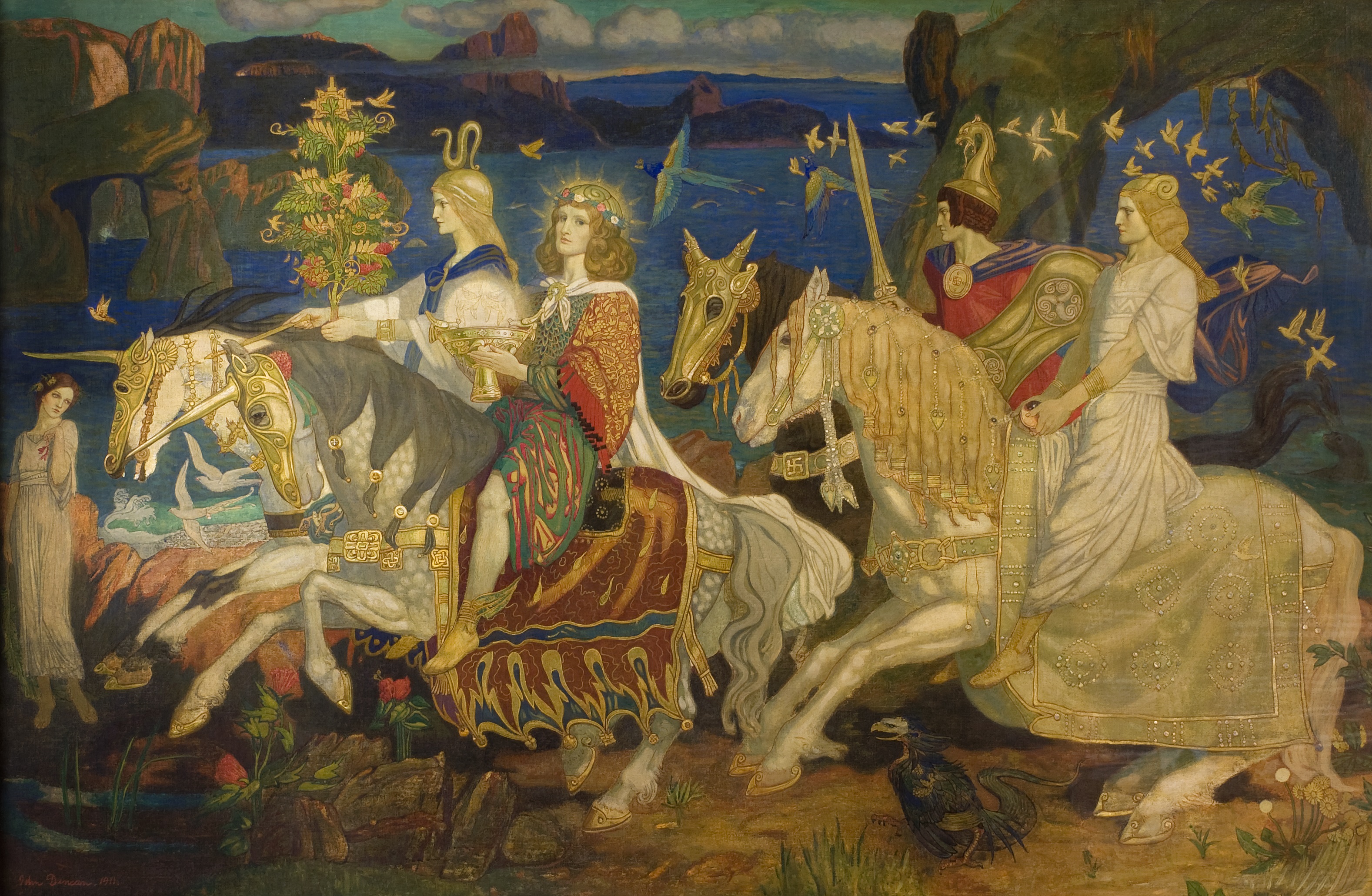
Image: The Riders of the Sidhe, John Duncan (1911), held at The McManus: Dundee’s Art Gallery and Museum.
Awen9 refers to divine poetic inspiration or creative spirit in Welsh, as well as Breton and Cornish. Awen is the flowing, inspirational muse of poets, bards, and painters, other artists. It is an energy or clarity that arrives unforced, perhaps as a gift or blessing, but can leave abruptly. Someone living in connection with Awen may be referred to as an Awenydd. We might now associate it with ‘creative flow’, but Awen is more fundamental. Awen has been referred to in Welsh poetry for over 1,200 years.

A symbol representing the Awen. The symbol is three lines as rays emanating from three points of light, which has been given various meanings (rays emanating from three points of light; earth, sea and air; body, mind and spirit; or love, wisdom and truth). The symbol is largely a Neo-Druid adoption and is often attributed to Iolo Morganwg in the 18th-19th century.
Image: Public Domain
Awen brings to mind those periods of inspiration and creativity on ‘good days’, and the conditions that may combine for this emergent experience. Even with chronic conditions, it is possible to feel creative, connected and even (in the case of autism and ADHD, for instance) experience highly immersive and enjoyable flow states.
In this sense, Awen might name not just creativity, but the felt arrival of capacity. These periods, and periods of remission, are not really predictable, however. There is a seam of variability in life with chronic conditions that affects functioning and capacity.
The Aos Sí may help to characterise this variability. Some symptoms are chaotic. Just as the Scottish Unseelie Court may harm people without reason, pain may afflict someone with fibromyalgia, dizziness may appear ‘out of the blue’ with Long Covid, or a flashback may occur within a person with PTSD. These experiences may occur with no clear cause, and for no reason that can be ascertained.
Other symptoms are more predictable, given certain actions or conditions. Autistic shutdown or meltdown may be foreseeable in sensory conditions that seem minor to non-autistic people. With ME/CFS, overexertion, especially repeated overexertion, makes a crash more likely. Even minor exertion can trigger a marked worsening of symptoms: post-exertional malaise (PEM). Similarly, actions that appear minor in the human world may receive a disproportionate reaction from the Aos Sí. The rules are different in the Otherworld.
Previous post in the series
Invisible worlds: Celtic folklore for living with chronic conditions and dynamic disability
Next post in the series
The reality of calculating exposure and energy: Geasa and tynged
References
- Shorrock, S. (2026, May 17). I crash: Texts from M.E. Humanistic Systems. https://humanisticsystems.com/2026/05/17/i-crash-texts-from-m-e/
- Shorrock, S. (2026, March 13). Reflections on the autistic spectrum: A critical response to Uta Frith’s views. Humanistic Systems. https://humanisticsystems.com/2026/03/13/reflections-on-the-autistic-spectrum-a-critical-response-to-uta-friths-views/
- Shorrock, S. (2020, October 10). PTSD and the multiple hourglass metaphor. Humanistic Systems. https://humanisticsystems.com/2020/01/31/ptsd-and-me/
- Wain, D., Williams, G., Charura, D., Hamilton, L. G., Milton, D., Wortman, D., & Heasman, B. (2026). Transitioning in and out of autistic flow: A qualitative study presenting a non‐pathologising approach to autistic well‐being and conceptualising autistic ways of being in clinical and therapeutic settings. Counselling and Psychotherapy Research, 26(1). https://doi.org/10.1002/capr.70073
- Murray, F. (2018, November 30). Me and monotropism: A unified theory of autism. The British Psychological Society. https://www.bps.org.uk/psychologist/me-and-monotropism-unified-theory-autism
- Durn, S. (2023, February 2). What is a fairy fort? Atlas Obscura. https://www.atlasobscura.com/articles/ireland-fairy-fort-ring
- Daimler, M. (2022). Pagan portal – Aos Sidth. Meeting the Irish fair folk. https://www.collectiveinkbooks.com/moon-books/our-books/pagan-portals-aos-sidhe-irish-fair-folk
- Fortune, M. (2022, May 5). Irish Fairy Folklore (Compilation from Mayo, Offaly, Tipperary and Wexford). YouTube. https://youtu.be/uRrwXTZMwp4?si=cXGvW-JiPXA_AkEG
- Wikipedia. (2026, May 28). Awen. Wikipedia; Wikimedia Foundation. https://en.wikipedia.org/wiki/Awen
Notes and Other Sources
- Tobar an Dualchais/Kist o Riches is dedicated to the presentation and promotion of audio recordings of Scotland’s cultural heritage. This recording (a mix of English and Gaelic) contains anecdotes regarding fairies and changelings.
- For an excellent, compact introduction to the Aos Si (Aos Sidhe in older Irish spelling), see “Pagan Portals – Aos Sidhe: Meeting the Irish Fair Folk“, by Morgan Daimler.
- There is an extraordinary YouTube channel run by Michale Fortune (Folklore.ie), which presents interviews and clips with Irish people about folklore. See for instance, this excellent Irish Fairy Folklore Compilation where elderly Irish men and woman talk about the consequences of offending the fairy folk, and this contemporary account on doing works around raths.
- Eddie Lenihan is Ireland’s most well-known storyteller who has been telling tales for over 35 years. Eddie shares Irish wisdom and stories from the past on the Tell Me A Story with Eddie Lenihan podcast.
- Several Blindboy episodes refer to Aos Sí (more often the Tuatha Dé Danann, the mythological ancient rulers of Ireland who retreated underground into a parallel spirit realm when humans arrived). In this episode, Blindboy interviews Eddie Lenihan, one of Ireland’s last true Seanchaí (traditional Gaelic storyteller and custodian of oral lore). Blindboy and Lenihan discuss fairy forts, the “Good People,” the dangers of crossing them, and Lenihan’s successful 1999 campaign to force the National Roads Authority to redirect a major bypass around a sacred fairy hawthorn bush in County Clare. Eddie’s own podcast episode on this is here.
- There is a spoken introduction to “The Divine Awen from Ancient Britain” by Stella Marie on YouTube here.
How to cite
Shorrock, S. (2026, 30 May). The reality of fluctuation and unpredictability: Aos Sí and Awen. Humanistic Systems. https://humanisticsystems.com/2026/05/31/the-reality-of-fluctuation-and-unpredictability-aos-si-awen/
One last thing…
My brother Gary Shorrock is taking on one of Britain’s most demanding endurance challenges: the Bob Graham Round in the Lake District on 27 June 2026. The funds raised through this challenge will go to ME Research UK, a charity that commissions and funds high-quality biomedical research into the causes, consequences, and treatment of ME/CFS.
Gary must cover around 66 miles, summit 42 fells, and climb more than 8,200 metres – approximately 26,900 feet of ascent – all within 24 hours. That means steep, rocky, boggy terrain, long hours on the move, and likely sections in darkness and harsh weather. The Bob Graham Round is an exceptional test of endurance, preparation, judgement, and determination. Only around 3,000 people have ever achieved it.
Gary has previously undertaken major endurance events and fundraising challenges, raising over £20,000 for a children’s hospital charity. Support for this fundraiser will help contribute to urgently needed research into ME/CFS – a devastating and neglected illness. Any donation would be greatly appreciated, and sharing the page would also make a big difference. Please see:
https://www.justgiving.com/page/gary-shorrock, or
Thank you for getting this far, and thank you for your support.
Steven and Gary Shorrock
Discover more from Humanistic Systems
Subscribe to get the latest posts sent to your email.
