
In any attempt to understand or intervene in the design and conduct of work, we can consider several kinds of ‘work’. We are not usually considering actual purposeful activity – work-as-done. Rather, we use ‘proxies’ for work-as-done as the basis for understanding and intervention. In this series of short posts, I outline briefly some of these proxies. (See here for a fuller introduction to the series.)
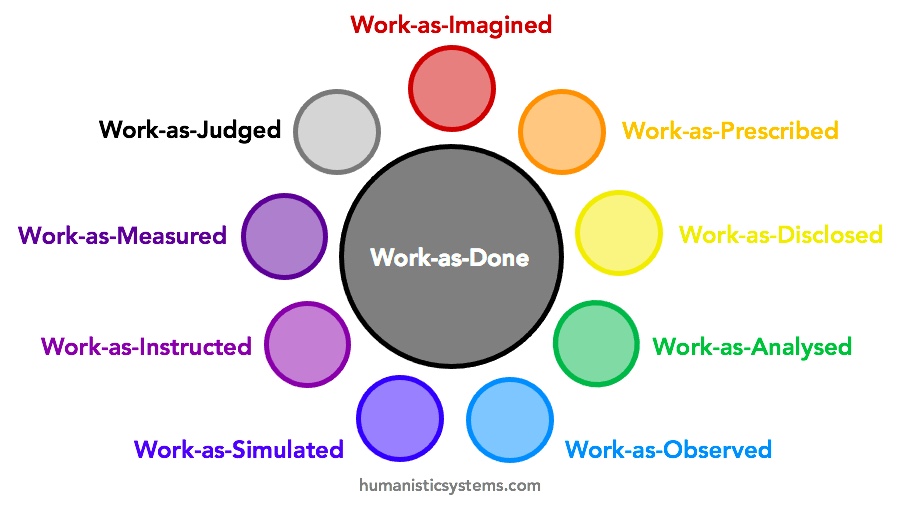
Other Posts in the Series
- Work-as-Imagined
- Work-as-Prescribed
- Work-as-Disclosed
- Work-as-Analysed
- Work-as-Observed
- Work-as-Simulated (this post)
- Work-as-Instructed
- Work-as-Measured
- Work-as-Judged
Work-as-Simulated
Work-as-simulated is the imitation of work-as-done.
Function and Purpose: Work-as-simulated is the imitation of work-as-done. Work-as-simulated is intended to help understand how work could be done in the future (e.g., new operating concepts or methods), how work was done in the past (e.g., recreation of a critical event), or how work is done now (e.g., where access to real environments is prohibitive). It may focus on any aspects of work, including physical (e.g., motor skills), mental (e.g., decision making), social (e.g., team behaviour), and organisational (e.g., communication, command and control). Work-as-simulated serves to update work-as-imagined and act as a platform for other proxies. Work-as-simulated has various purposes concerning work design and evaluation (e.g., handling unusual events, incident command), artefact design and evaluation (e.g., interface and tool design), facility design (e.g., room layout), competency and training (e.g., teamwork training), and safety and business continuity (e.g., disaster planning).
Form: Work-as-simulated is sometimes classed as: 1) ‘live’ (real people operating real systems, e.g., real-time simulation in the actual work environment), 2) ‘virtual’ (real people operating simulated systems, e.g., a physical simulator, virtual reality simulation, shadowing of live work in another environment in real time with mock inputs, and potentially mental practice, table-top simulation); 3) and ‘constructive’ (simulated people operating simulated systems, e.g., computer-generated real- or fast-time simulation).
Agency: Work is simulated with and by a wide array of agents, professions or functions. Human-in-the-loop work-as-simulated may involve the people who usually do the work, others representing these people, mannequins, and digital models (including digital human models). Work-as-simulated may involve professionals in a variety of roles such as training, competency assessment, human factors, work psychology, user research, operations research, safety, and operational support and senior management.
Variety: Compared to work-as-done, work-as-simulated typically has a more limited range of possibilities in terms of activity due to controls and constraints on system interactions and the environment (e.g., programmed exercises, lines of communication, physical environment). For real-time simulation involving people, different actors will perform in different ways, as with in-situ work-as-done.
Stability: Work-as-simulated is dynamic and may be interactive, but the environment is often more predictable (at least to those involved in simulation design), with various ‘extraneous variables’ controlled. The stability of the simulator platform will also influence stability of work-as-simulated.
Fidelity: Work-as-simulated should imitate work-as-done, but fidelity will vary significantly. It is often impossible to simulate all aspects of work-as-done. This is because of: a) limitations associated with the imagination and planning of scenarios (e.g., outages, emergencies); b) limitations associated with simulator platforms and environments (e.g., the number and nature of alarms; fidelity of physical equipment or virtual environments; fidelity of interactions); c) limitations associated with simulator personnel (e.g., superusers who are not representative of all users; unrealistic responses by agents representing real actors, such as pseudopilots, bots, and mannequins). Still, advances in computing have increased the fidelity potential of work-as-simulated significantly by improving the ability to represent interactions and aspects of the work context (e.g., anatomical details in virtual reality healthcare simulation; vehicle handling; air traffic movements).
Completeness: Work-as-simulated may focus on work generally (for a defined period), a specific scenario, a task or sub-task, depending on the purpose of the simulation and the possibilities and constraints. When simulating human work, there is usually a focus on specific objectives (typically relating to skill learning or design evaluation), which will tend to narrow the scope of work-as-done that is simulated. Combined with other proxies, it is possible to get a good understanding of work-as-done for a variety of purposes in a variety of contexts.
Granularity: Work may be simulated at the same kind of granularity as in-situ work-as-done (e.g., 90 minutes in a flight deck or air traffic control simulator), or at a more micro level (e.g., part task simulation; fine motor skills training), or macro level (e.g., fast time simulation of team activity patterns).
This work is licensed under a Creative Commons Attribution-NonCommercial-NoDerivatives 4.0 International License. CC BY-NC-ND 4.0

 Humanistic Systems