
If you have ever read an analysis or report about work you know very well, especially the work that you do, you may have experienced a discrepancy. Perhaps you recognised most of the elements, but still felt that it didn’t add up. Something important was missing.
What was missing may be found in the relationships and interactions with others, or in the small adaptations, adjustments and compromises that were necessary, or in how you felt, such as confidence or trust. It may have been something indefinable about what it took to get the work done, or what doing it was like. An account may not be inaccurate, in that what is said is not wrong, while being inadequate – especially in what it leaves out – leaving us with a poor understanding of the work.
Specialists producing such analyses and reports, including human factors specialists, safety and quality specialists, and designers, can observe the same thing from the other side of the fence. An air traffic controller friend once remarked to me that task analyses (some of which break down work hierarchically from goals to individual actions) are technically right, but somehow wrong. Work can be broken down hierarchically, but doing so destroys something important about the complex dependencies, variation and feelings. Representations of work can look right while feeling wrong, because, in important ways, they are.
We have been representing work in all sorts of ways – textually, numerically and diagrammatically – for many years. Artificial intelligence gives us new, powerful ways to produce such accounts. Recordings and reports can be analysed en masse, patterns identified, and findings presented in detailed, fluent and credible summaries. These capabilities can save enormous effort and help us discover things we would otherwise miss. But these capabilities also come with a cost; they make it easier to believe that we have understood enough.
So what happens when these accounts become the basis for decisions about people’s work? And what happens when the people doing the work try to tell us something that the account does not contain, or perhaps contradicts the account? Could an organisation become more informed while becoming less aware of how work actually happens, and how people make it possible?
Representations of work
Organisations have always had difficulty understanding work. Much of what people do is difficult to observe, describe and measure. Even the people doing it may struggle to explain how they anticipate an event, recognise something or judge a situation. We are not even aware of how we work all of the time. Understanding work is the basis for my own work, but it takes time and expertise (as well as willingness) that is in short supply in organisations. And so people do their work, often without others really understanding what they are doing, how or even why.
In previous posts, I have explored the varieties of human work – work-as-imagined, work-as-prescribed, work-as-disclosed and work-as-done – and associated patterns or archetypes. I extended these basic four varieties to cover other proxies through which we try to understand work-as-done (including work-as-observed, work-as-measured, work-as-analysed, work-as-simulated, work-as-instructed.) Each is necessary and important.1 But proxies are also partial and potentially misleading. Each proxy also involves choices, such as what to include in a policy or procedure, what to disclose in a conversation or report, who to observe, what to measure or simulate, and how to analyse. These choices influence what becomes available for us and others to imagine and judge (see Figure 1).
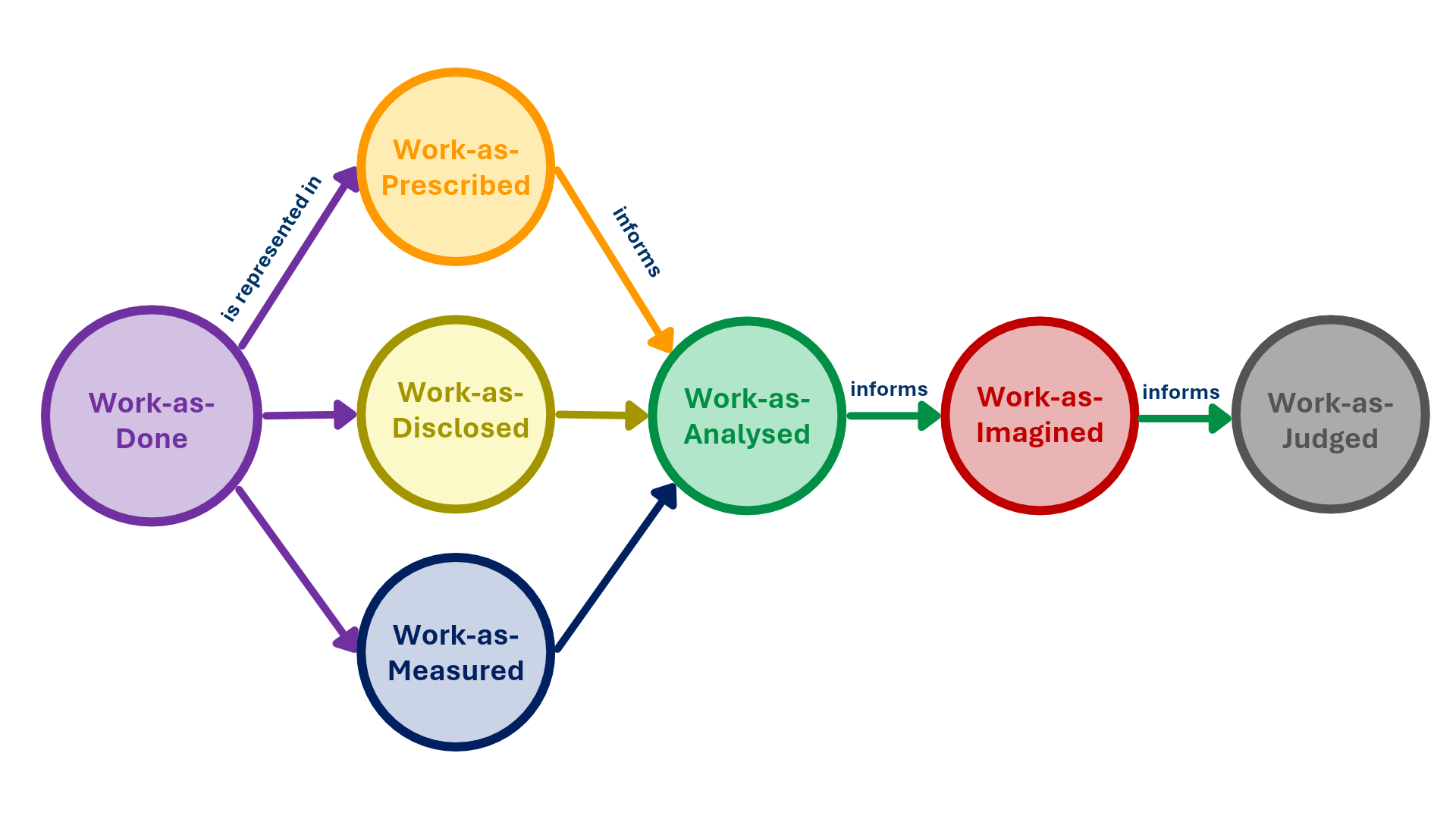
© Steven Shorrock (2026). Licensed under CC BY-NC 4.0.
We need these representations. They are necessary to design, coordinate, manage, explain and improve work. But a problem arises when we lose sight of the relationship between a representation and the work it is intended to represent. More data does not necessarily solve the problem, and may make it worse.
“More data does not necessarily solve the problem, and may make it worse.”
In his article The Tyranny of Light, organisational theorist Haridimos Tsoukas (1997) challenged the techno-optimism of the early dot-com era. He examined the attraction of treating knowledge as information that can be detached from people and circumstances. His paper argued that late-modern society has stripped knowledge of its human context, turning it into abstract, commodified data. This overabundance of data yields three major temptations:
- Information reductionism: The belief that the natural and social worlds can be entirely reduced to chunks of data.
- The conduit metaphor: The assumption that information is totally objective, neutral, and exists independently of human interpretation.
- Social engineering: The belief that collecting more data will make society fully transparent, allowing social and organisational problems to be rationally engineered away.
When institutions act on these temptations – shining the “light” of data, metrics and indicators onto everything – paradoxes can arise. First, more information may lead to less understanding as decontextualised data loses the local, practical nuances required to make sense of a situation. Second, more information may undermine trust as institutional behaviour is subjected to audits, rankings and league tables, interpreted by people who are remote from the work. Third, efforts to make society (and by extension organisations) more governable may achieve the opposite: decisions become increasingly reactive, and people adapt to the indicators through which their performance is judged. The representations begin to shape the reality they are intended to describe. And it is worth reflecting on this: our judgements of work depend on how we imagine it through these representations.
AI gives these temptations greater power and a new means of expression: we can generate increasingly comprehensive and sophisticated accounts and become increasingly confident that we understand what they describe. A clear account may bring together many sources convincingly, but it may also leave little indication of what is missing, such as what was not said or done, what was felt, or what cannot be categorised.
Tsoukas drew on a proposal in The Sunday Times by Roy Lilly, then Chairman of the Federation of NHS Trusts resources committee in England, to install cameras in operating theatres. The intention was to make operations safer, hold surgeons more accountable for their performance, and provide documentary evidence in case patients sue. Tsoukas wrote that “A camera hears only what can be articulated, not what is tacit; it conveys only what can be seen, not what is taken for granted.” (p. 835). He noted that medical practice is a complex social practice that cannot be fully accounted for through an externalist perspective. It certainly cannot capture thoughts and feelings. He explained that the information from the cameras may come “at the expense of trust”.
This brings us back to the distinction between accuracy and adequacy. A recording may accurately preserve what was clearly visible and audible while leaving us unable to understand everything that was not (e.g., sensations, perceptions, thoughts, feelings). Whether the representation is adequate depends partly on what we intend to use it for.
Surrogation
An earlier warning came from cyberneticist Stafford Beer. In an address delivered in 1971 (published in 1973), he described how “people often begin to mistake the model for the reality – and start managing the model instead” (p. 199). Beer recognised that models necessarily intervene between management and the situation being managed. His concern was that an inadequate model could be treated as reality and remain unchanged while the situation moved on, becoming a surrogate for the world it was intended to represent.
Tsoukas (1997) picked up on the theme, writing that “Information becomes a surrogate for the world – what is actually going on tends to be equated with what the relevant indicators (or images) say is going on.” (p. 833).
In research on strategic performance measurement, Choi and colleagues have used the noun surrogation to describe a tendency to treat performance measures as though they were the strategic constructs they are intended to represent (Choi et al., 2012). By extension, surrogation can occur when an organisation treats work-as-measured as sufficient understanding of work-as-done.
This concern remains even when accounts are continually updated. An AI-supported account may incorporate new data (e.g., reports) regularly, while continuing to ask the same questions. The findings would be updated, but important aspects of work may remain outside the account because nobody has reconsidered what to ask, record or investigate. In other words, new information may refresh the account without bringing us closer to aspects of work that were never recorded or considered relevant. The problem cannot be resolved simply by improving data quality or keeping the model current.
“New information may refresh the account without bringing us closer to aspects of work that were never recorded or considered relevant.”
We can extend this idea further to representations of human work, including those produced or transformed using AI. Building on Beer’s account of “the surrogate world we manage”2, the concern here is how AI-supported representations of human work: a) acquire authority, b) influence whose experience counts, and c) change the conditions under which organisations can continue to learn about work. We are already accustomed to a category (e.g., “human error“) becoming a causal explanation for disasters in complex systems, but with AI, an elegant textual summary, a diagrammatic representation, a detailed table or fancy dashboard may gain more power than they deserve. People may then make decisions about work on the basis of AI-procured accounts (in turn based on previous measures and recordings) that miss some of the most important details.
AI may increase this possibility through the speed and scale at which representations and accounts can be produced, and through their fluency and apparent coherence. The underlying assumptions and limitations may become less visible. This is a risk, with an associated opportunity. The same capabilities can help people compare interpretations, find contradictions, trace sources and formulate better questions. Much depends on the purpose for which the analysis is used, and how it is performed.
What makes an account convincing?
Have you ever noticed how a number reported more precisely (say, to two decimal places) can seem more convincing? Research by Zhang and Schwarz (2012) found that people expressed greater confidence in the accuracy of estimates communicated in finer-grained terms, such as days rather than years. The detail appeared to convey something about the communicator’s knowledge (although the effect also depended on assumptions about the communicator’s reliability).
There is a related question about textual accounts. Research on processing fluency shows that ease of processing can influence judgements of truth. Reber and Schwarz (1999), for instance, found that statements presented in more readable colours were more likely to be judged true. The concept has been used to consider how the presentation of an account affects its reception.
More directly, Steyvers and colleagues (2025) found that people tended to overestimate the accuracy of large language model answers when given the models’ default explanations. Longer explanations increased confidence even when the additional length did not improve accuracy. Their experiments were not in the field of organisational life, but they demonstrate that an explanation can increase confidence without a corresponding increase in correctness.
So might a fluent, detailed analysis or assessment receive more weight than a hesitant account from someone doing the work? Let’s say a practitioner is trying to express a change that they have only recently noticed, that perhaps varies between situations, or that they do not yet know how to explain. They are still making sense of the weak signals – it’s a gut feeling, perhaps – but they have sensed that something is off. In a world of polished AI accounts, what confidence can we have in such hesitant human accounts?
What receives organisational attention?
So this is the question: what receives organisational attention, and how might this change with the increasing use of AI? To receive attention, something has to be visible. This is an idea discussed by Star and Strauss (1999) in their writing about visible and invisible work. They emphasised that visibility depends on context and the indicators through which work is recognised. Something apparent and important to you and your colleagues (e.g., relationships, confidence, trust, willingness to seek help, camaraderie, enjoyment in work) may be invisible to management, and entirely missing from any report. It’s not that these are ‘invisible’ to everyone, but distance from the context makes them so.
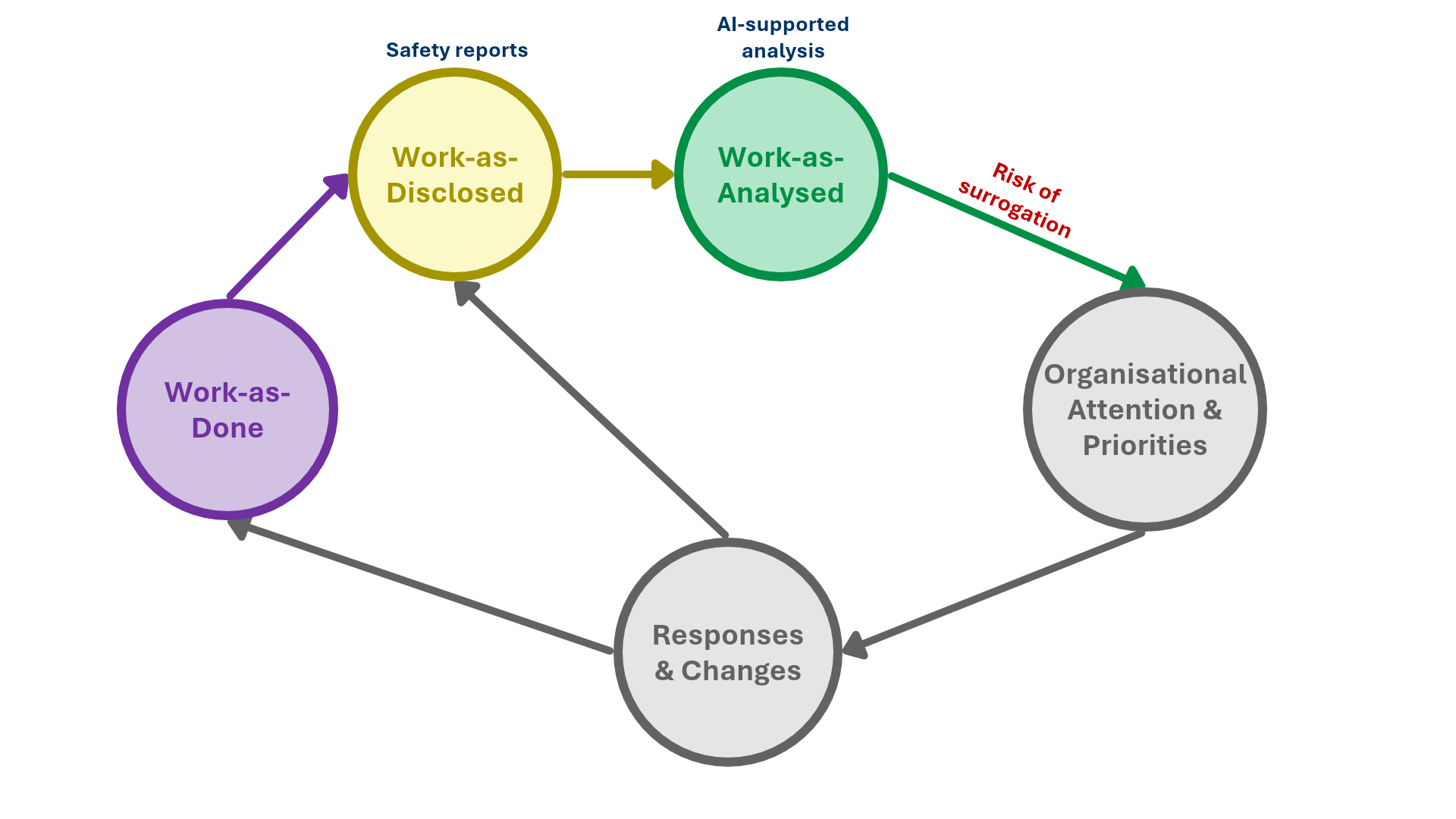
Now let’s say that AI is used for processing reports from staff (e.g., safety reports). AI-enabled analysis creates the possibility for much more analysis of what is submitted, with the risk of a self-reinforcing cycle (see Figure 2):
- Safety reports (work-as-disclosed) become available for AI-supported analysis (work-as-analysed).
- The analysis attracts organisational attention and helps establish priorities. Surrogation becomes a risk when it is treated as sufficient understanding of the work.
- What receives attention and is prioritised influences decisions about resources and work.
- Responses and changes influence work-as-done and work-as-disclosed.
Experiences that are not disclosed may remain absent from the analysis, including that which is below the surface of awareness, taken for granted, or hard to put into words.
© Steven Shorrock (2026). Licensed under CC BY-NC 4.0.
In Dysfunctional Consequences of Performance Measurements, V. F. Ridgway (1956) observed that even measures introduced purely to provide information “are probably interpreted as definitions of the important aspects of that job or activity” (p. 247). An explicit target, limit or reward is therefore not necessary for a measure to redirect attention and effort. People work out quickly what gets organisational attention, and act accordingly (to attract or avoid it). We should consider how AI-generated analyses and assessments may, even more powerfully, suggest what the organisation considers important.
Sociologists Wendy Espeland and Michael Sauder (2007) referred to how people change their behaviour in response to being evaluated or measured as reactivity. Their research concerned law school rankings, which influenced the institutions they purported to describe. Applying this idea to AI in organisations, we need to consider how an AI-produced or supported assessment might change the conditions under which the next set of reports is produced.
Practitioners are sensitive to measurement via its consequences. They learn what the organisation recognises as significant and acts upon, and what the organisation seems to ignore. They adapt their accounts accordingly. And they may well also use AI where possible…
“Practitioners are sensitive to measurement via its consequences. They learn what the organisation recognises as significant and acts upon, and what the organisation seems to ignore.”
Such adaptations may be protective. Ridgway described workers restricting output because an increase could become the basis for a higher quota. Similarly, people may become cautious about disclosing how they manage difficult work if they expect that disclosure to justify fewer resources, unhelpful constraints, or greater demands. The organisation may then hear less about the effort and adaptations that make work possible, especially where people fear losing the conditions upon which those contributions depend.
If a concern is repeatedly discounted because it does not appear in more visible, fluent accounts, people may stop raising it. The organisation then receives less evidence of the concern, making its existing or dominant account appear even more convincing. This is not a new phenomenon – I have witnessed this many times even without AI. In one case, air traffic controllers reported that they were not ready to transfer to a new air traffic control unit, but these reports were not believed or acted on by management, partly because records indicated that controllers were passing training (which focused on whether they could use new equipment and understood procedures, but not whether they could do the job as a whole). One source of information said one thing, another source of information said another. In a second simpler example, controllers in a tower had repeatedly asked for a crash alarm, but one was never provided, so they stopped asking. AI may amplify this process by making some accounts more prominent and persuasive, while leaving little indication of the experiences that people have stopped disclosing.
Whose account counts?
The UK Post Office Horizon scandal offers a severe and tragic historical warning about the authority given to a technological account. Horizon is the Post Office’s accounting system, operated by Fujitsu and rolled out across the Post Office branch network from 1999. Horizon recorded transactions and calculated how much cash and stock each branch should hold. Sub-postmasters were contractually required to cover apparent shortfalls themselves. The system offered no way to dispute its figures before accepting them and moving into the next trading period, even when sub-postmasters believed them to be wrong.
Horizon contained bugs that could generate substantial discrepancies. Sub-postmasters struggled to challenge these because they lacked access to the technical information needed to investigate them. Meanwhile, Post Office call-centre staff were instructed to tell complainants that they were the only ones experiencing problems. The Post Office used its investigation and prosecution powers to prosecute more than 700 sub-postmasters between 1999 and 2015, with consequences including imprisonment, criminal records and bankruptcy.
In 2009, Computer Weekly reported the experiences of seven sub-postmasters who attributed apparent shortfalls to faults in Horizon. The scandal illustrates how a technological account can acquire institutional authority while the people challenging it lack both the information and means to have their experiences properly investigated. The Post Office Horizon scandal resulted in what the Criminal Cases Review Commission described as “the biggest single series of wrongful convictions in UK legal history”.
In Hamilton and Others v Post Office Ltd (2021), the Court of Appeal described how those concerned with prosecutions maintained that Horizon data was accurate and “effectively steamrolled over any SPM [sub-postmaster] who sought to challenge its accuracy” (para. 121). Sir Wyn Williams reached a similarly stark conclusion in the Post Office Horizon IT Inquiry’s report: “throughout the lifetime of Legacy Horizon, the Post Office maintained the fiction that its data was always accurate” (Williams, 2025, para. 1.4). The fiction was defended despite evidence that should have prompted its investigation.
Horizon is an accounting system that does not use AI. Its relevance here lies in the organisational response to conflicting evidence (human vs. machine), levels of trust in human versus technological accounts, and failures to investigate and disclose discordant information. The people challenging the account faced an institution committed to defending it: “POL knew that there were serious issues about the reliability of Horizon” (Hamilton and Others v Post Office Ltd [2021], para. 121), but it did not “appear that any attempt was made to investigate” (para. 121).
In other settings, the difference between accounts may be less direct and less stark. Practitioners may describe something that AI-analysis was never intended or equipped to examine. Before deciding which account is right, we need to ask whether they address the same question.
Consider a hypothetical change to communication and coordination procedures that reduces routine contact between neighbouring units (air traffic control units, hospital units, etc). Practitioners describe growing unfamiliarity with each other’s circumstances and greater hesitation about asking questions or seeking help. AI-supported analysis finds that recorded coordination problems remain low. The question is how AI-supported analysis helps us investigate work, and when its account becomes sufficient for organisational purposes.

© Steven Shorrock (2026). Licensed under CC BY-NC 4.0.
Practitioners’ accounts are also representations. They can be incomplete, selective, mistaken, and difficult to articulate, and colleagues doing apparently similar work may experience and describe it differently. My experience is that these differences reveal something, often something quite important. Understanding work requires opportunities to explore such differences, including between people in different roles and positions.
Finally on the question of “whose account counts?”, there is the issue of epistemic injustice: the unfair treatment of people in their capacity to contribute knowledge. Disagreement alone does not establish epistemic injustice. But when someone’s experience is given less credibility because of their status or position, or their ability to communicate it fluently, or because it does not fit an institutionally-preferred account, the organisation risks losing knowledge as well as treating the person unfairly.
Waites and Burnell (2023) described pilots reporting pressure associated with a changed ground procedure. The response reframed their concern as a one-off process error, and the pilots eventually stopped reporting the problem and developed workarounds. Their account illustrates how an organisation’s interpretation of reports can affect what people subsequently feel it is worth reporting, even without AI.
What makes questioning possible?
Discussions about AI, following older discussions about automation, often turn to over-reliance and ‘complacency’. These are valid concerns, but they need to be considered in the circumstances of work. How much time is available to investigate an output? What happens to someone who questions an assessment that others have accepted? What does the organisation reward and punish?
We may even doubt our own questioning, as our locus of evaluation changes. Carl Rogers (1959) defined this as “the source of evidence as to values” (p. 210), differentiating between an internal and external locus of evaluation (‘external’ referring originally to other people). Drawing on this idea, we might ask whether people increasingly turn to AI-generated assessments to judge their own experience. If an authoritative account repeatedly conflicts with what they experience or notice, they may begin to discount their concerns before raising them. Others may continue to challenge it at considerable personal cost.
At an organisational level, a similar shift may occur when AI-supported accounts become the basis for judging work and deciding what matters. The question is whether people retain the confidence, opportunities and authority to bring their own experience into those judgements.
Thirty years ago, Charles Billings’ NASA report on human-centred aviation automation emphasised the importance of meaningful involvement and authority sufficient to fulfil responsibility (Billings, 19963). This remains relevant when AI supports organisational decisions. A person formally responsible for reviewing an assessment needs the information, capability, time and authority to examine it and act on what they find.
The European Union Aviation Safety Agency’s (EASA) proposed Issue 3 of its AI Concept Paper also addresses the relationship between responsibility and the authority, information and means to fulfil it. Its organisational guidance includes continued assessment using end-user evaluations, and its ethics guidance considers professional threats and effects on wellbeing and mental health (EASA, 20264). These proposed provisions provide useful prompts for organisational practice.
The ability to question AI therefore depends on more than a personal attitude or motivation. It depends on the design of work and the organisation’s response to questioning. We need to consider whose judgement can influence a decision, and whether that influence can be exercised in practice.
“The ability to question AI therefore depends on more than a personal attitude or motivation. It depends on the design of work and the organisation’s response to questioning.”
Where does the time go?
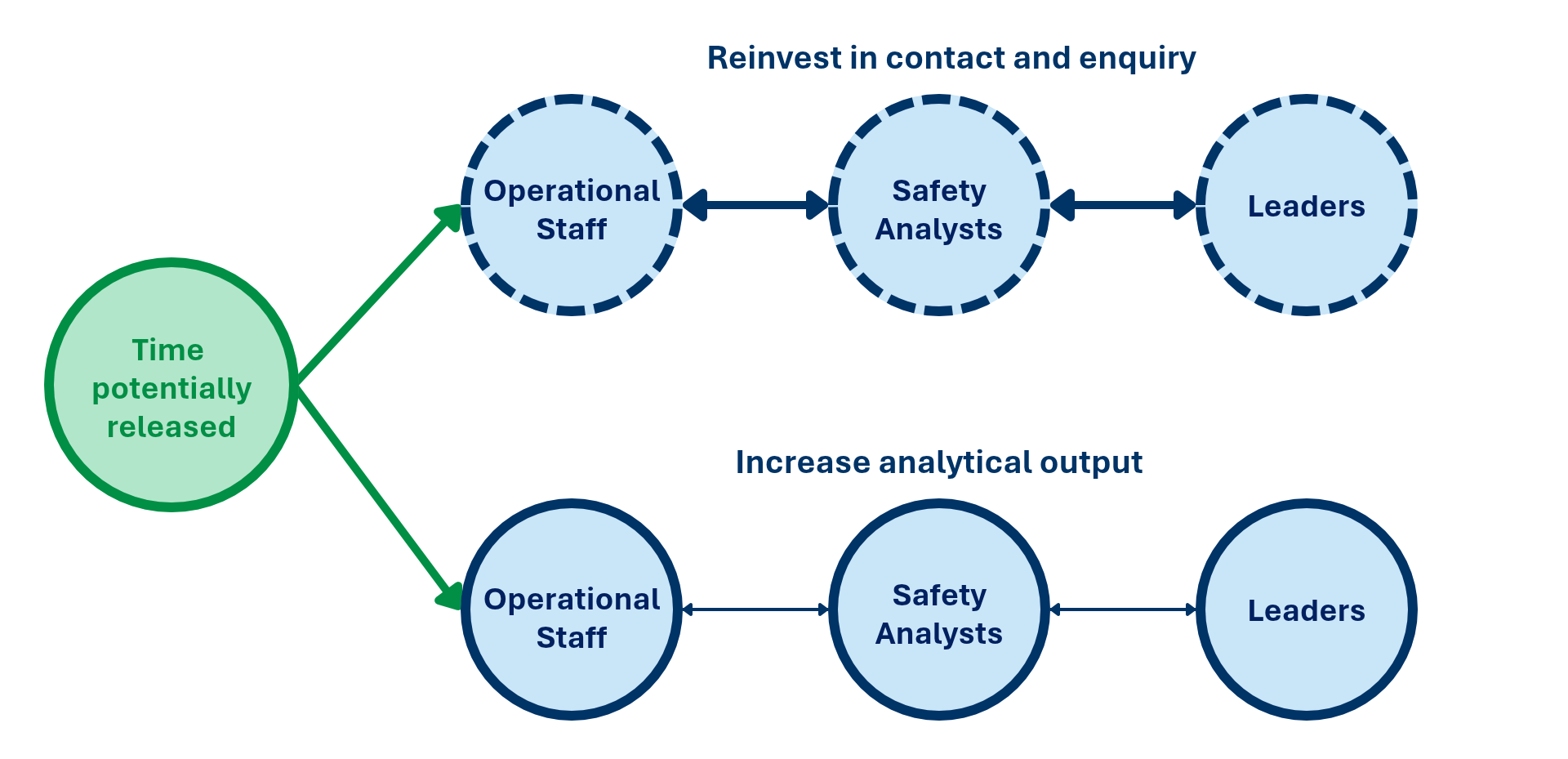
Returning to the issue of reports, AI may release significant time previously spent coding and classifying reports, preparing summaries and searching for trends and patterns. Before assuming a saving, we need to account for the ‘repair work’ of checking, interpreting, correcting and coordinating the use and outputs of AI (Elish and Watkins, 2020). (Some of this work may be transferred to people whose additional effort is not included in the original assessment of benefits.)
Where net time is released, its use is an organisational choice. Ridgway (1956) discussed the familiar “ratchet principle”, whereby improved performance becomes the new standard. If AI releases capacity, organisations may absorb it into higher expectations before considering what else that capacity could support. We could produce more analyses, reports and presentations, or create more opportunities to understand work through direct contact with the people doing it (see Figure 4). (We could also protect opportunities for practitioners to talk to one another, including across roles and organisational boundaries.)
© Steven Shorrock (2026). Licensed under CC BY-NC 4.0.
The choice has implications for future capability. Lave and Wenger’s (1991) account of situated learning emphasises learning through participation in communities of practice. This directs attention to the occasions through which people develop judgement: working alongside others, asking questions, contributing to difficult tasks and gradually taking more responsibility. When introducing AI, we need to ask what happens to those opportunities.
A Human Factors or safety specialist who spends time observing operations and exploring awkward situations with practitioners is developing knowledge and relationships that will shape later interactions and subsequent analysis. If those opportunities diminish, we need to ask where that understanding will come from, especially for people entering the profession. Some effects will take years to become apparent. An organisation may retain experienced people who can recognise what an AI-generated account has missed, while successors never acquire that ability.
“An organisation may retain experienced people who can recognise what an AI-generated account has missed, while successors never acquire that ability.”
Examine the analysis, explore the work
There are two complementary forms of inquiry that organisations need to support. Each offers something different, and each requires different knowledge, skills and conditions. Examining AI-generated analysis involves questioning sources, categories, assumptions, uncertainty, gaps, etc, and conclusions. It requires enough understanding of the analytical process to recognise what an output can support and where further evidence is needed. It also requires enough understanding of the work to ask whether the analysis has attended to what matters.
Exploring the work involves observation, conversation, and joint inquiry with practitioners. It requires curiosity, listening, sensitivity to relationships and power, and the ability to investigate situations without prematurely fitting them to a familiar explanation (a risk of experience). People may need time and help to express something that has become ordinary to them, or that they have never previously been asked to explain, and this needs to be done in the right context. Spending time with air traffic controllers and engineers has been the greatest source of learning for my job. Whether it is in an ops room, simulator, control and monitoring position or meeting room to host a focus group or interview, these occasions have added the messy but important details to whatever procedural or technical understanding I had, and often acted as important ‘model corrections’. Sadly, when I ask, practitioners often say that it is rare that someone outwith their clan takes such an interest. (Human Factors specialists often find themselves as the ‘go-betweens’, connecting operational staff concerns with management attention [for a discussion of Human Factors practitioner roles, see Williams and Shorrock, 2016].)
These inquiries should inform one another. Analysis may reveal a pattern that prompts a useful conversation, and a conversation may expose a gap in the analysis or suggest a different question. AI can assist this process, including by helping people explore alternative interpretations and future possibilities.
Inquiry also needs to be able to open the possibility to act. In Beer’s terms, we need opportunities to ‘revise the model’ when it fails to help us understand the situation, and the means to change the conditions that the inquiry reveals. When practitioners contribute their experience, who can change the technology, procedures, resources or conditions of work? How will those practitioners know what happened to their contribution? An organisation can become adept at collecting accounts while making little use of what people are trying to tell it. If data are precious now, agency will be precious as we move on.
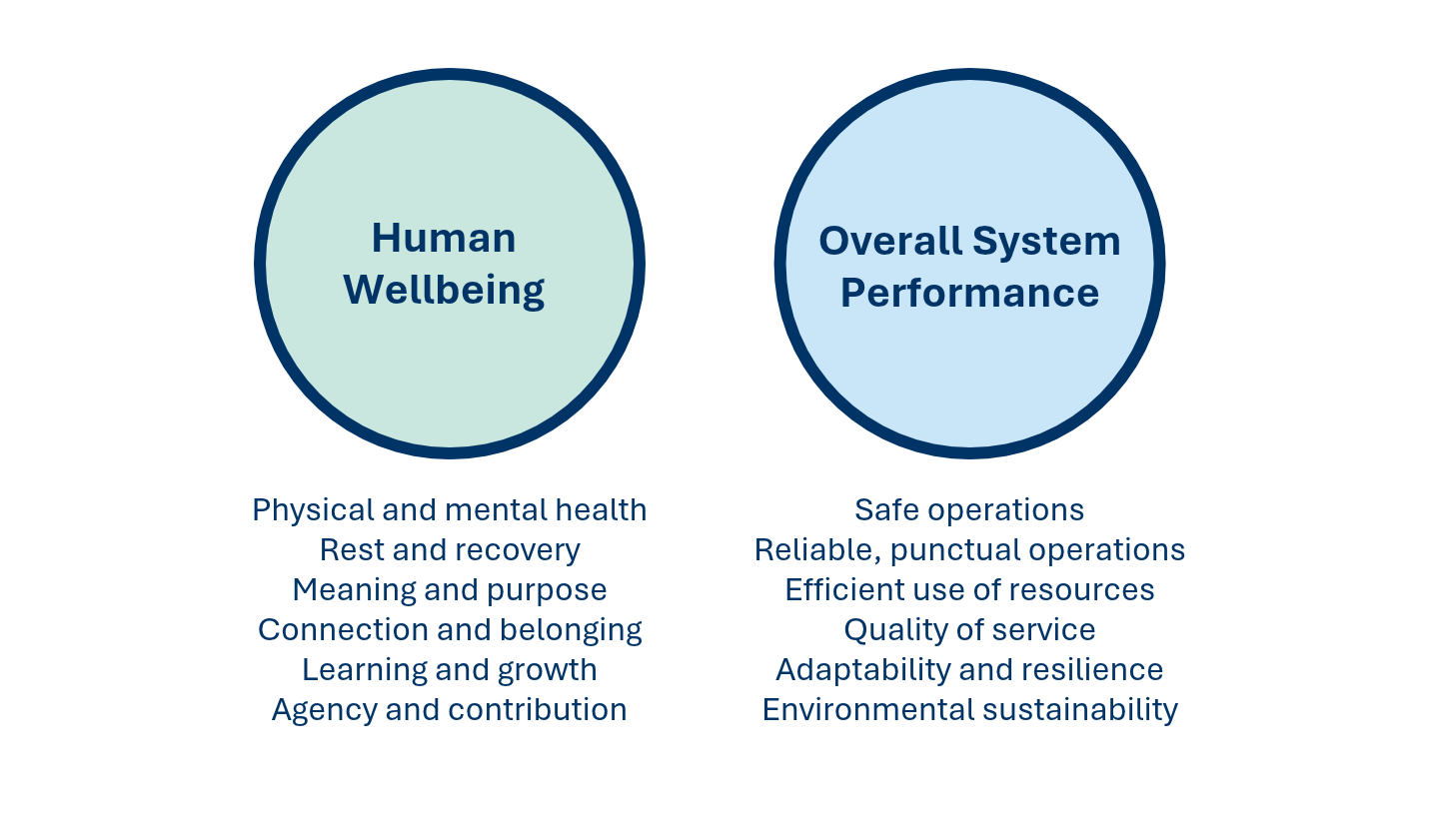
But what is this all for? Human wellbeing and overall system performance are the twin aims of human factors and ergonomics (International Ergonomics Association [IEA], n.d.). They also provide useful criteria for evaluating design and management, including the integration of AI into organisations. We should ask whether AI helps people do worthwhile work well, strengthens their ability to learn and adapt, and improves the conditions in which they work, as a basis for both human wellbeing and overall system performance (see Figure 5).
© Steven Shorrock (2026). Licensed under CC BY-NC 4.0.
These twin aims also give us a basis for considering whether an AI-supported analysis, assessment or account is adequate for its intended use. Does it help us understand the implications for people’s wellbeing and overall system performance? An account may accurately describe recorded outcomes while revealing nothing about the effort, relationships and conditions that make those outcomes possible. If someone recognises the account but feels that something important is missing, we have a reason to continue the inquiry.
AI can help us examine representations of work and ask better questions. Whether this brings us closer to understanding work depends on the opportunities we retain to explore it with people, the credibility we give their contributions, and their ability to influence what happens next. Our response will also shape what people feel able, or think it worthwhile, to disclose in future.
We might begin with an AI-supported assessment that is relevant to an organisational decision, and explore it with the people whose work it represents. What does it help us see? What does it leave out? What needs further investigation, and what should change? The value of the account ultimately depends on how it helps us improve the work and the conditions of the people doing the work.
These reflections informed my contribution to the Flight Safety Foundation webinar AI & Safety: Let’s Talk About People, on 28 October 2026, with Nadine Bienefeld and Jon Holbrook, moderated by Tzvetomir Blajev, organised with the support of Immanuel Barshi.
References
Beer, S. (1973). The world we manage. Behavioral Science, 18(3), 198–209.
Beer, S. (1975). Platform for change. John Wiley & Sons.
Billings, C. E. (1996). Human-centered aviation automation: Principles and guidelines (NASA-TM-110381). NASA.
Choi, J., Hecht, G. W., & Tayler, W. B. (2012). Lost in translation: The effects of incentive compensation on strategy surrogation. The Accounting Review, 87(4), 1135–1163. https://doi.org/10.2308/accr-10273
Criminal Cases Review Commission. (n.d.). Post Office ‘Horizon’ cases. https://ccrc.gov.uk/post-office-horizon-cases/
Elish, M. C., & Watkins, E. A. (2020) Sepsis watch in practice. https://medium.com/datasociety-points/sepsis-watch-in-practice-5b06f88655fe
European Union Aviation Safety Agency. (2026). EASA concept paper: Guidance for safety-related artificial intelligence applications (Proposed Issue 03, June 2026). https://www.easa.europa.eu/sites/default/files/dfu/easa_concept_paper_guidance_for_artificial_intelligence_applications_proposed_issue_03.pdf
Espeland, W. N., & Sauder, M. (2007). Rankings and reactivity: How public measures recreate social worlds. American Journal of Sociology, 113(1), 1–40. https://doi.org/10.1086/517897
Hamilton and Others v Post Office Ltd [2021] EWCA Crim 577. https://www.judiciary.uk/wp-content/uploads/2022/07/Hamilton-Others-v-Post-Office-judgment-230421.pdf
International Ergonomics Association. (n.d.). What is ergonomics (HFE)? https://iea.cc/about/what-is-ergonomics/
Lave, J., & Wenger, E. (1991). Situated learning: Legitimate peripheral participation. Cambridge University Press. https://doi.org/10.1017/CBO9780511815355
Reber, R., & Schwarz, N. (1999). Effects of perceptual fluency on judgments of truth. Consciousness and Cognition, 8(3), 338–342. https://doi.org/10.1006/ccog.1999.0386
Ridgway, V. F. (1956). Dysfunctional consequences of performance measurements. Administrative Science Quarterly, 1(2), 240–247. https://doi.org/10.2307/2390989
Rogers, C. R. (1959). A theory of therapy, personality, and interpersonal relationships, as developed in the client-centered framework. In S. Koch (Ed.), Psychology: A study of a science: Vol. 3. Formulations of the person and the social context (pp. 184–256). McGraw-Hill.
Shorrock, S. (2020). Proxies for work-as-done: 1. Work-as-imagined. Humanistic Systems.
Shorrock, S. (2026). Supporting the people who make safe operations possible. Humanistic Systems.
Star, S. L., & Strauss, A. (1999). Layers of silence, arenas of voice: The ecology of visible and invisible work. Computer Supported Cooperative Work, 8(1–2), 9–30. https://doi.org/10.1023/A:1008651105359
Steyvers, M., Tejeda, H., Kumar, A., Belem, C., Karny, S., Hu, X., Mayer, L. W., & Smyth, P. (2025). What large language models know and what people think they know. Nature Machine Intelligence, 7, 221–231. https://doi.org/10.1038/s42256-024-00976-7
Tsoukas, H. (1997). The tyranny of light: The temptations and the paradoxes of the information society. Futures, 29(9), 827–843. https://doi.org/10.1016/S0016-3287(97)00035-9
Waites, J., & Burnell, J. (2023). Epistemic injustice: The dog has now been removed from the tail. HindSight, 35, 18–20. https://www.eurocontrol.int/sites/default/files/2023-10/eurocontrol-hindsight-magazine-35.pdf
Williams, C., & Shorrock, S. (2016). Human factors are ergonomics practitioner roles. In S. Shorrock & C. Williams (Eds.) Human factors and ergonomics in practice: Improving system performance and human wellbeing in the real world (pp. 95-108). Routledge. https://www.routledge.com/Human-Factors-and-Ergonomics-in-Practice-Improving-System-Performance-and-Human-Well-Being-in-the-Real-World/Shorrock-Williams/p/book/9781472439253
Williams, W. (2025). Post Office Horizon IT Inquiry report: Volume 1 (HC 1119). https://www.postofficehorizoninquiry.org.uk/sites/default/files/2025-07/Post%20Office%20Horizon%20IT%20Inquiry%20Final%20Report%20Volume%201_0.pdf
Zhang, Y. C., & Schwarz, N. (2012). How and why 1 year differs from 365 days: A conversational logic analysis of inferences from the granularity of quantitative expressions. Journal of Consumer Research, 39(2), 248–259. https://doi.org/10.1086/662612
Footnotes
- Stafford Beer recognised models as necessary intermediaries: “the model intervenes between the manager and the situation. It must do this; it is a kind of filter intended to cut out noise and enhance perception of meaningful patterns.” ↩︎
- The original paper later appeared as “The surrogate world we manage” in a reprint of the same address: Beer, S. (1975). The surrogate world we manage. In Platform for change (pp. 397–416). John Wiley & Sons. ↩︎
- See especially pp. 7-11 and 117-118. ↩︎
- See responsibility assessment, p. 151; organisational provisions, pp. 152-155; ethics-based assessment, pp. 51-52. ↩︎
How to Cite
Shorrock, S. (2026, October 29). Artificial intelligence and the surrogation of human work. Humanistic Systems. https://humanisticsystems.com/2026/10/29/artificial-intelligence-and-the-surrogation-of-human-work/
Discover more from Humanistic Systems
Subscribe to get the latest posts sent to your email.
